Italian unification
The Florios of SicilyItalian unification is the culmination of a campaign to end Bourbon rule and the beginning of another struggle over who will govern Sicily and command its resources. In the novel, the passage from revolt to national union is neither a simple liberation nor a clean break: the new state arrives with the language of unity, but extends its own laws, taxes, and commercial system across the island without accommodation. Sicily is freed from one ruling power only to be left, in the narrator’s stark formulation, once again a conquered land.
Causes and Political Context
The unification movement grows out of a longer history of political subjection and renewed revolutionary hopes. After the Bourbon return, Sicily’s autonomy has already been sharply curtailed. Since December 1816, Neapolitans have administered state offices and customs, and Neapolitan officers have commanded the military. Heavier taxes, restrictions, and constraints on trade worsen an economy already struggling; Palermo has lost the power and independence that its merchants and inhabitants had once possessed. These experiences make the question of sovereignty immediate and material: control of government also means control of customs, trade, and the terms on which local wealth can circulate.
By the period of the final campaign, unrest is again smoldering. Clandestine publications and failed popular uprisings sustain resistance, while nobles and members of the intellectual middle classes look toward Victor Emmanuel II, king of Sardinia, as a means of freeing Sicily from Bourbon subjection. The novel presents Francesco Crispi as a figure who helps bring these strands together. He proposes an insurrection supported from outside Sicily, with the larger objective of Italian unity, and persuades Giuseppe Garibaldi by telling him that an uprising has already begun in Palermo. That account refers to the Gancia revolt, which Crispi directs from April 4 to 18, 1860.
Campaign and Formation of the Kingdom
Without the king’s explicit support, Garibaldi and the Expedition of the Thousand set sail from Quarto on May 5, 1860. The volunteers, recognizable by their red shirts, land at Marsala on May 11 and reach Salemi on May 14. There Garibaldi proclaims himself dictator of Sicily in the name of Victor Emmanuel II. The route and its declarations give the expedition a double character: a military intervention in support of Sicilian rebels and a campaign already framed as serving a future Italian state.
The volunteers march on Palermo on May 28 and are welcomed as liberators. They later reach Naples on September 7. On October 26, Garibaldi meets Victor Emmanuel II at Teano, an encounter the narrative marks as the beginning of the Kingdom of Italy. The sequence moves quickly from a local revolt to a national political settlement, but the account does not equate the language of liberation with the transfer of lasting authority to Sicilians themselves.
Annexation and Its Consequences
After unification, officials from the Kingdom of Sardinia extend their legislative, economic, fiscal, and trading systems to southern Italy and Sicily without adapting them to local circumstances or accepting compromise. The change therefore reaches beyond the replacement of a sovereign: it reorganizes the rules under which the island is governed and its economy operates. The novel emphasizes that the new administration does not treat Sicily as a partner whose particular conditions must shape the settlement.
The consequences are unequal across society. The nobility cannot preserve its privileges and loses a sense of cultural identity; ordinary people continue to endure an economy that functions under difficult conditions and offers little prospect of improvement. The narrative places this political outcome beside the earlier Bourbon loss of Sicilian autonomy, making the new order legible not simply as national consolidation but as a repeated transfer of power away from the island.
Palermo and the Florios After Unification
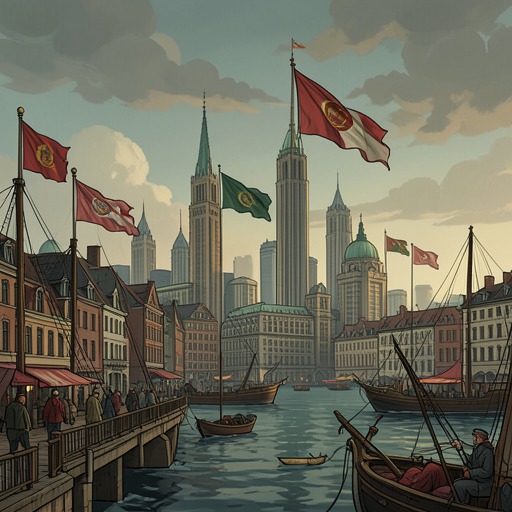
Palermo receives the new rulers with a mixture of anticipation and distrust. The city seems suspended at the threshold of an uncertain future, waiting to learn what those who arrived as liberators will demand. Its suspicion has a history: Palermo has known too many conquests. The image of the city as a mistress who appears to yield to all yet belongs only to herself gives the political transition a local, intimate scale. The city is not merely a prize in a national campaign; it is a place with its own stubborn identity, shaped by successive rulers without being wholly possessed by any of them.
The Florios’ commercial and public roles bring the costs of the transition into view. During the 1848 revolution, Vincenzo Florio had already bought a large consignment of rifles in England on behalf of the revolutionary committee. He describes trading as having fallen by half since the revolt began, while the revolutionary regime has requisitioned the Sicilian Steamship Company’s vessel Palermo for troop transport. He resents the use of his resources to finance a conflict, even as he recognizes Ruggero Settimo’s commitment and willingness to reason. This earlier crisis foreshadows the later tension between political projects and the merchant’s accumulated capital: public authority repeatedly turns to ships, money, and commercial capacity when it needs them.
During the transfer of power in 1860, Vincenzo acts as a trade governor at the Royal Bank. Leaving Ignazio behind in Via dei Materassai because he does not want him involved, Vincenzo orders all the cash and bank drafts transferred into the safe. He expects that once the crisis has passed, the money will have to return to circulation or be converted into the kingdom’s new currency. The bullion in the treasury is harder to protect: Garibaldi’s men are expected to requisition a substantial gold supply within hours. The scene renders regime change as an immediate contest over deposits, drafts, currency, and state-held gold—not an abstraction distant from the countinghouse.
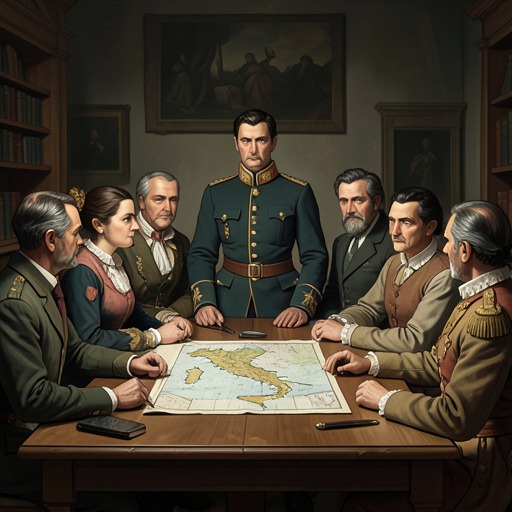
The confrontation continues in Vincenzo’s argument with Giulia after annexation. She urges him to consider the good that might come from a single nation stretching from the Alps to Marsala, and asks what the sacrifices made for that ideal mean to him. Vincenzo instead accuses the Piedmontese of turning Sicily into a colony and objects that the Bourbon Crown treasury has been seized and taken to Piedmont to pay the annexation campaign’s expenses. He rejects the idea that unification guarantees freedom from external control. His anger is also personal: he wants his world, and the Casa Florio, protected from interference. The dispute exposes the divide between national unity as a collective ideal and sovereignty as something experienced through the security of local institutions, property, and trade.
The Novel’s Measure of Unity
The novel places Italian unification within a longer material history in which political authority and commerce are inseparable. Spices reach Palermo through long chains of travel, handling, and transport; wholesalers use warehouses at Palazzo Steri to hold goods in transit and pay import tariffs only when merchandise actually enters the city. Under Bourbon rule, Neapolitan control of customs and trade restrictions damages an already weakened economy. Under the revolutionary government, ships are blocked or requisitioned, and commercial capacity becomes military transport. After annexation, the Sardinian system is imposed across Sicily without adjustment. Across these changes, control of the routes, rules, and reserves that sustain trade remains a practical measure of sovereignty.
That material emphasis sharpens the contrast between the promise and the outcome of unification. The expedition is welcomed in Palermo as liberation, and Teano signals the beginning of a kingdom built around national unity. Yet the new state’s refusal to compromise leaves Sicilians subject to distant decisions, while the island’s economic hardship persists. The ending is not a denial that the Bourbon regime has been displaced; it is a refusal to treat displacement as sufficient proof of self-government. By calling Sicily once again a conquered land, the narrative makes the unresolved question of political belonging the final measure of the Risorgimento’s victory.